
Current Job Opening:
CNC machinist in Delbrück (near Lippstadt)
Your tasks as a CNC machinist:
- Independent milling of components on 3- and 5-axis milling machines
- Setup and adjustment work on CNC-controlled machines
- Independent manufacturing and testing of individual parts
- Quality assurance using common measuring and testing equipment
We are a good fit for you if:
- Completed training as a cutting machine operator, industrial mechanic, or toolmaker, possibly with further training as a CNC specialist
- Experience with CNC controls, preferably Heidenhain (iTNC530)
- Reliability, teamwork, and the ability to work independently
- Shift readiness
Ebbesmeyer offers you
- A varied role in a collegial environment
- Performance-based pay
- Regulated working hours
An explanation
The profession of CNC milling machine operator
CNC mill operators work on computer-controlled milling machines and produce complex components for mechanical engineering, aerospace, medical technology, and many other industries. It is a profession that combines technical understanding, manual dexterity, and a passion for precision.
We offer various training programs in this field. Therefore, it is important to us to introduce the specializations early on. Learn more about the profession of a CNC milling machine operator.

What does a CNC machinist do?
The daily work is far more than just „pushing buttons.“ It's a complete process from planning to the finished, tested component.
- Planning and Preparation:
- Reading Technical Drawings You are the be-all and end-all. The CNC miller analyzes the design drawings and understands the required dimensions, tolerances, surface finishes, and materials.
- Define workflow: Based on the drawing, the most efficient way to manufacture the part is planned: What machining steps are necessary? In what order?
- Machine programming:
- Create or adapt CNC programs: The machinist writes the code that controls the machine or calls up existing programs and adapts them. This can be done directly on the machine control (e.g., Heidenhain, Siemens Sinumerik) or externally with CAM (Computer-Aided Manufacturing) software.
- Select tools: For each work step, the appropriate tool (milling cutter, drill bit, thread cutter) is selected from a tool library and stored in the program.
- Setting up the machine
- Clamp workpiece The workpiece (e.g., a metal block) is securely and precisely fixed on the machine table. This requires a lot of experience.
- Use tools: The selected tools are inserted into the machine spindle or tool magazine and measured.
- Set null points: The milling cutter determines the exact starting point of the machining operation on the workpiece, so that the machine knows where it is in space.
- Manufacturing Oversight
- Break-in process The first run of a new program is monitored with particular care to avoid collisions and optimize the process (feed rate, rotational speed).
- Ongoing Monitoring: During machining, the milling machine operator monitors the machine, listening for sounds, checking chip formation, and ensuring the supply of coolant.
- Quality Control and Follow-up
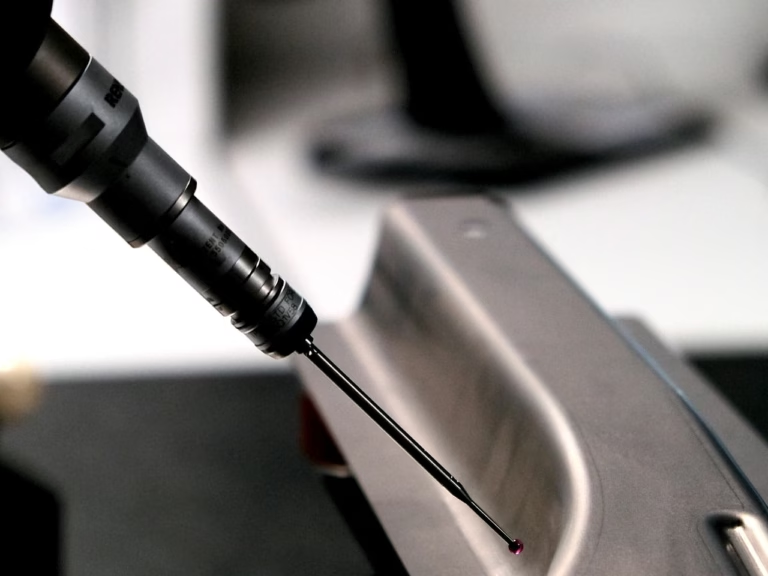
- Measurement and Testing: After processing, the finished component is inspected using high-precision measuring instruments (calipers, micrometer, 3D measuring arm) to ensure that all dimensions and tolerances have been met.
- Documentation The measurement results are recorded in test protocols.
- Deburring and Finishing Sharp edges are removed, and the component is prepared for further processing or shipping.
What degree is required?
The most common path is through a dual vocational training program in the metalworking sector.
- The classical education: The ideal prerequisite is a completed vocational training as:
- Machinist (specializing in milling technology) This is the most accurate and in-demand training for this profession.
- Precision mechanic (specializing in mechanical engineering or toolmaking): This training also provides an excellent foundation.
- Tool Mechanic Here too, knowledge of metalworking and handling machinery is very relevant.
- A good secondary school leaving certificate (Hauptschule or Realschule) is generally the required educational qualification.
- Career change Skilled workers from other metal trades (e.g., industrial mechanics, construction mechanics) can also qualify as CNC milling machine operators through targeted further training and courses (e.g., CNC training programs). Professional experience and technical talent are often crucial here.
- Key Skills (Soft Skills):
- High degree of precision and quality awareness
- Good spatial reasoning skills
- Technical and mathematical understanding
- Independent and solution-oriented way of working
- Teamwork and reliability
What are typical job titles?
In job postings and everyday professional life, you'll find various titles that are often used interchangeably. Using the correct titles is important for your job posting.
- CNC Milling Machine Operator The most common and direct title.
- Machining Technician The official job title, often used in formal contexts.
- CNC Specialist / CNC Operator / CNC Operator Often used for positions where operating and monitoring already set-up machines is the main focus.
- CNC Setup Technician Emphasizes the ability to independently prepare machines for new orders.
- CNC Programmer A specialized role with a focus on the creation and optimization of CNC programs.
- 5-axis milling machine operator An designation for absolute specialists who master complex machining on 5-axis machines. (Especially relevant for us!)
At its most beautiful
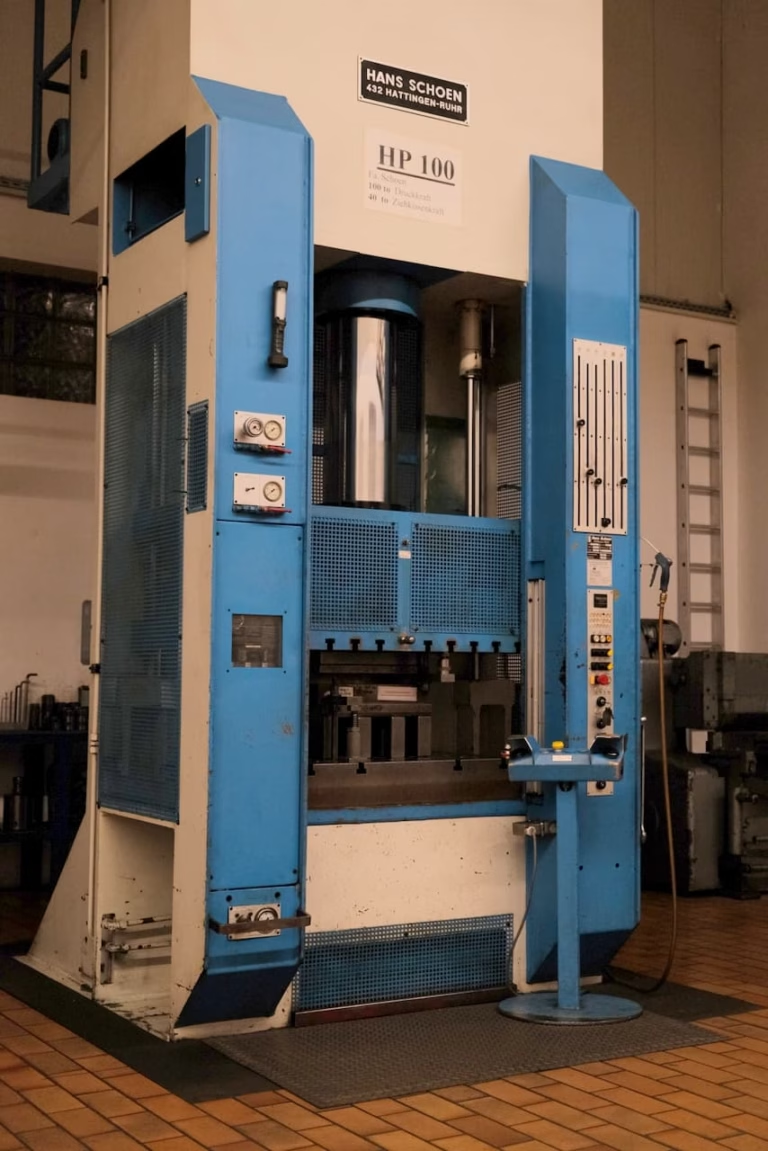
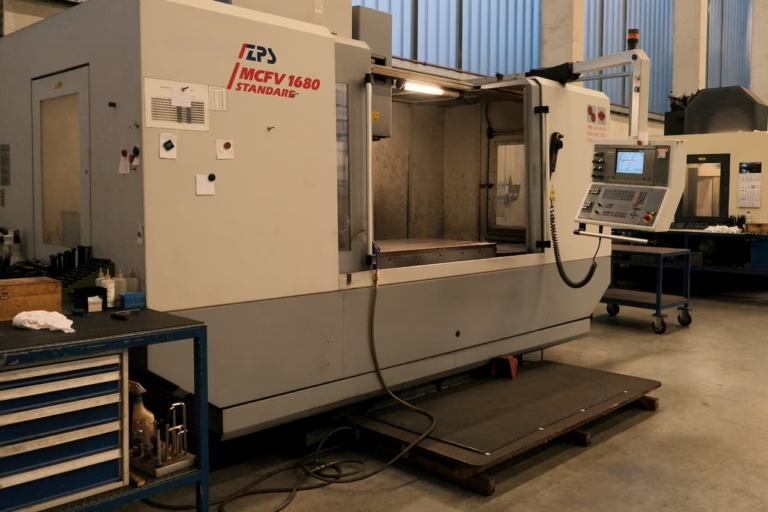
Our machinery
We'll show you a selection from our machine park, because we love our tools.
 German
  English